Know your chimney before you build around it.
Honest inspections and sweeping across the Twin Cities metro and surrounding suburbs — plus free clearance guides for homeowners, remodelers and anyone adding a mantel.
Planning a project near your fireplace?
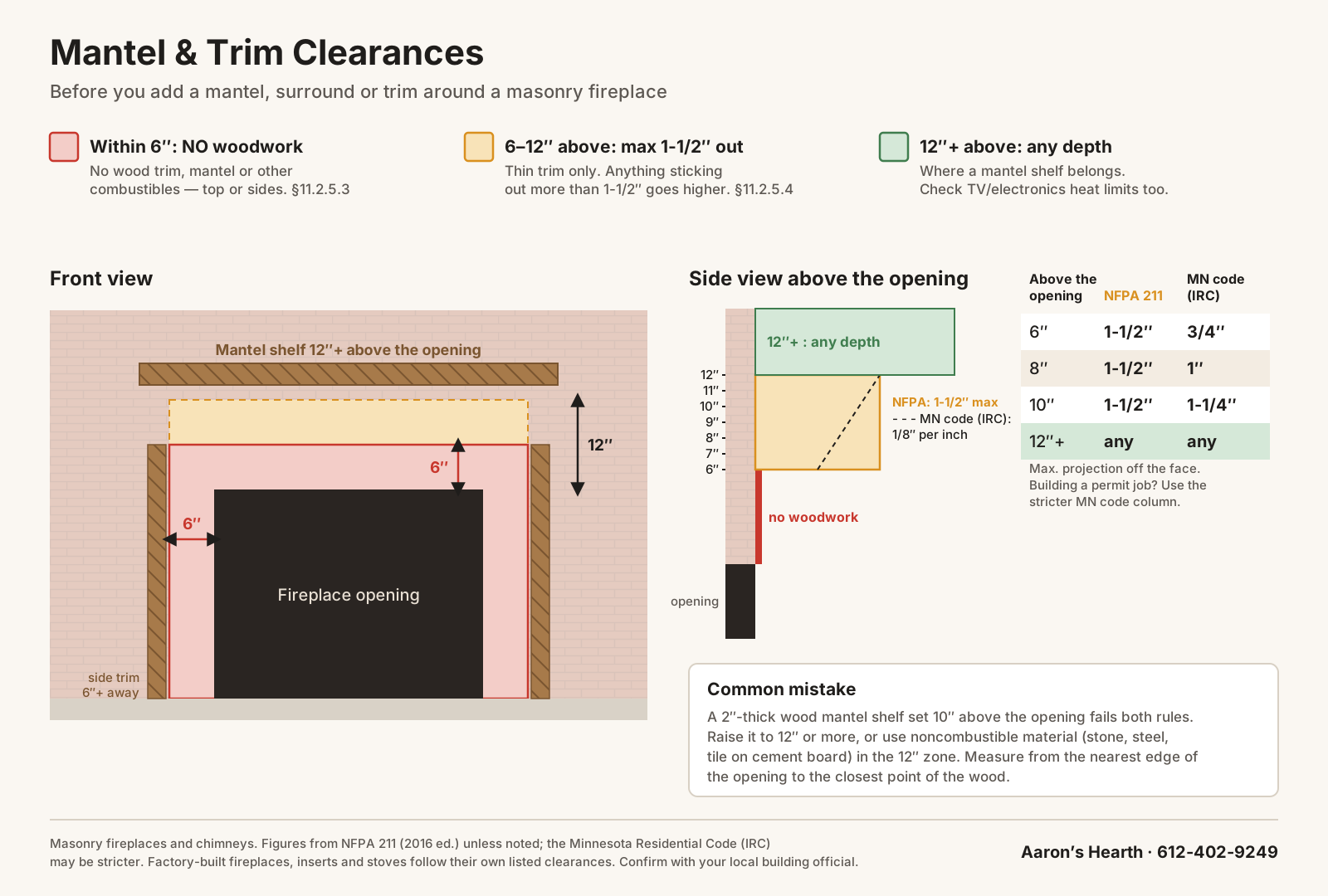
Most chimney fire hazards we find weren’t built that way. They were added later: a wood mantel set a few inches too low, flooring run up to the firebox, spray foam packed against the chimney during a basement finish.
These mistakes are cheap to avoid and expensive to fix after the drywall is up. Our guide shows the numbers in plain pictures, so you or your contractor can get it right the first time.
We tell you what matters — and what doesn’t.
We show you what we find
Every inspection comes with photos and a plain-English explanation of what each finding means for your safety — not a sales pitch.
“Older” isn’t “dangerous”
Plenty of chimneys don’t match every line of today’s standard and still work safely. NFPA 211 says its rules aren’t retroactive unless there’s a real hazard. We tell you which is which.
Repairs only when something’s wrong
Liners, smoke chamber parging and firebox rebuilds fix real problems: damage, poor draft, or construction that’s an actual fire risk. They aren’t the automatic answer to an inspection.
Look it up before you call anyone
Clearance guide
Mantels, hearths, framing and chimney height in plain diagrams.
Liner sizing
What size you need, whether it fits, and the manufacturers’ rules.
Buying a home
What “recommend further evaluation” means and what to ask.
Chimney fires
Signs during and after, and what to do before you burn again.
Is this quote reasonable?
Questions to hold any chimney recommendation up to.
Switching to gas
Why gas doesn’t make an old fireplace code compliant.
What we do
Chimney sweeping
Thorough cleaning of creosote and debris, with a Level 1 inspection every time.
Inspections: Level 1, 2 & 3
Level 2 includes a full camera scan of the flue. Level 3 only when there’s a real reason to open things up.
Liner inspection & installation
When an existing flue is cracked, failing or the wrong size for the appliance — not as a default upsell.
Smoke chamber parging
Sealing rough or deteriorated smoke chambers so heat and gases stay where they belong.
Firebox rebuilds
Repairing or rebuilding cracked, loose or burned-out fireboxes.
Crowns, caps & screens
Stopping water, animals and sparks at the top of the chimney.
Fireplace doors & screens
Fitting and installation for safer, cleaner fires.
Dryer vent cleaning
Clearing lint buildup, one of the most common causes of house fires.
Integrity over sales quotas
At Aaron’s Hearth, the foundation of good chimney work is safety, quality and honesty — not exploiting codes for the sake of sales. Codes exist to keep your family safe. They don’t call for changes without a legitimate reason, like a real hazard or a new appliance.
We evaluate your chimney thoroughly and recommend repairs only when they’re essential for safety and performance.
Accountable to you, not a logo
I used to be certified. I let it go because, in my experience, the certifying organizations don’t hold their certified companies accountable when an installation is done wrong or an inspection gets it wrong. A certificate on the truck doesn’t mean anyone stands behind the work — the homeowner is the one left holding it. I refuse to be guilty by association.
So I earn trust the direct way: photos of what I find, a clear explanation of what matters, and my name on the work.
— Aaron
Get in touch
Call or text 612-402-9249. Planning a remodel? Text a photo of your fireplace and a quick sketch of the project and we’ll tell you if anything looks close.