Liner sizing guide

What size liner does your chimney need?

Understand the size before anyone quotes you. This page shows the sizing rules, how to measure the space you have, and the manufacturers’ own installation requirements.

First: do you need a liner at all? A sound clay tile liner that’s the right size for what you burn doesn’t need replacing. Liners make sense when the existing flue is cracked or missing, sized wrong for the appliance, or when a new stove or insert is going in. See our inspection approach.
Sizing calculator

Run your numbers

Estimates only. The appliance manual and the liner’s listing have the final say.

Open fireplace

Wood stove or insert

Filled in: a standard 8½ × 13 tile, about 6½ × 11 inside.

The rules

How flue size is set

Open fireplaces

The flue has to be big enough for the fireplace opening (width × height). For a chimney at least 8 ft tall above the opening with no offsets:

  • Round flue: at least 1/12 of the opening.
  • Square, or rectangular/oval under 2:1: at least 1/10.
  • Rectangular/oval 2:1 or longer: at least 1/8.

NFPA 211 §7.1.11.3. Taller, shorter or offset chimneys are sized by engineering methods (§7.1.11.2).

Wood stoves & inserts

  • Flue area no smaller than the stove’s flue collar, unless the stove manual says otherwise.
  • No more than 3× the collar area for an interior chimney.
  • No more than 2× the collar area if any chimney wall is exposed outside below the roofline.

In practice, a stove or insert gets a full stainless liner to the top, sized to the collar and insulated per the liner’s listing. At minimum it needs a positive connection to the flue liner. The real question is usually whether the insulated liner fits — often it doesn’t fit inside the old tile.

NFPA 211 §13.4.4, §13.4.5.1; liner listings (UL 1777) require insulation for wood and coal.

Round liner sizes and the largest fireplace opening each can serve
Round linerArea (sq in)Max opening, straight chimney (1/12)Max opening, 1/10 rule
5-1/2″23.8285238
6″28.3339283
7″38.5462385
8″50.3603503
10″78.5942785
12″113.11,3571,131

Sizes are inside diameter, which is how stainless liners are sold. For a round clay liner, measure the actual inside diameter at the top. Don’t go by the label or the outside.

A typical 36″ × 24″ opening is 864 sq in, so it needs a 72 sq in flue: a 10″ round liner. That’s why many open fireplaces end up with rigid or oval liners, or a smaller opening.

Insulation & clearance

Insulation decides the clearance — and the fit

Wood and coal liners must be insulated per their listing. Which insulation, and how thick, also decides whether the reline counts as zero clearance to wood framing that touches the chimney. Check the listing for your exact liner and insulation — the clearance rating belongs to the tested system, not the material in general.

Poured mix (TherMix, BEST-Mix, HomeSaver InsulationMix)

UL 1777 listed for zero clearance with a listed stainless liner — but only with at least 1″ of mix all the way around the liner.

Fit: the cavity must be at least liner outside + 2″. A 6″ liner needs about 8-1/4″ clear — very tight in a 2-brick chimney, and the liner has to stay centered so no side gets thin.

Blanket wraps (ceramic wool)

Depends on the liner system. National Chimney and HomeSaver list a 1/2″ wrap for zero or reduced clearance. BEST-Flex lists only 1″ of poured mix for a zero-clearance chimney — its 1/4″ wrap is for code chimneys with the tile removed.

If the wrap isn’t listed for zero clearance in your system, the chimney still needs its normal air space to wood.

Not listed for zero clearance?

Then the reline is only code if the chimney has its normal air space to combustibles: 2″ for an interior chimney, 1″ for an exterior one — and that space stays empty.

NFPA 211 §7.3.1, Table 7.2. A camera scan or attic/basement check shows whether framing is touching.

The mesh isn’t optional. Every blanket-wrap manual above calls for a protective mesh sleeve (ArmorMesh, Premier Mesh, a wire mesh sock, or expandable stainless mesh) pulled over the insulation and clamped. It keeps the blanket from tearing or sliding off as the liner goes down. Skip it and the install doesn’t match the listing — and a torn wrap can leave bare liner against the masonry.

TherMix: 1″ minimum for UL-listed zero clearance with listed stainless liners in a 4″ masonry chimney (DuraVent TherMix bulletin). HomeSaver UltraPro manual: under 1″ clearance, use a 1/2″ wrap, two 1/4″ wraps, or 1″ of mix. Always follow the manual for your liner.
Round vs. oval vs. squared

Reshaping a liner shrinks it

A flexible liner keeps the same circumference when you squeeze it into an oval or square to fit a tile. The same length of steel goes around a flatter shape, so it encloses less area — and the more you flatten it, the more you lose.

  • Ovalizing a 6″ liner to fit a 6″ stove can leave you smaller than the collar. Start with a 7″ round and ovalize that instead.
  • An oval 2:1 or longer needs 1/8 of a fireplace opening, not 1/10 (NFPA 211 §7.1.11.3.4).
  • Some manuals don’t allow reshaping at all (Dalsin’s says not to). Factory oval and rectangular liners are listed at their true area.

Ovalize calculator

Same liner, different shapes — area in sq in (percent of round)
Round sizeRoundLight oval (narrow = 80%)Heavy oval (narrow = 60%)Squared (sharp corners)
5-1/2″23.84.4 × 6.5″
22.5 (95%)
3.3 × 7.3″
19.0 (80%)
4.3 × 4.3″
18.7 (79%)
6″28.34.8 × 7.1″
26.7 (95%)
3.6 × 8.0″
22.6 (80%)
4.7 × 4.7″
22.2 (79%)
7″38.55.6 × 8.3″
36.4 (95%)
4.2 × 9.3″
30.7 (80%)
5.5 × 5.5″
30.2 (79%)
8″50.36.4 × 9.5″
47.5 (95%)
4.8 × 10.6″
40.1 (80%)
6.3 × 6.3″
39.5 (79%)
10″78.58.0 × 11.8″
74.2 (95%)
6.0 × 13.3″
62.7 (80%)
7.9 × 7.9″
61.7 (79%)
12″113.19.6 × 14.2″
106.9 (95%)
7.2 × 16.0″
90.3 (80%)
9.4 × 9.4″
88.8 (79%)

Ovals calculated as an ellipse with the same perimeter as the round liner; flattened-side ovals land slightly higher. Squared figures assume sharp corners, the worst case — rounded corners land between square and round. Inside dimensions, before insulation.

Measuring your flue

How much room do you have?

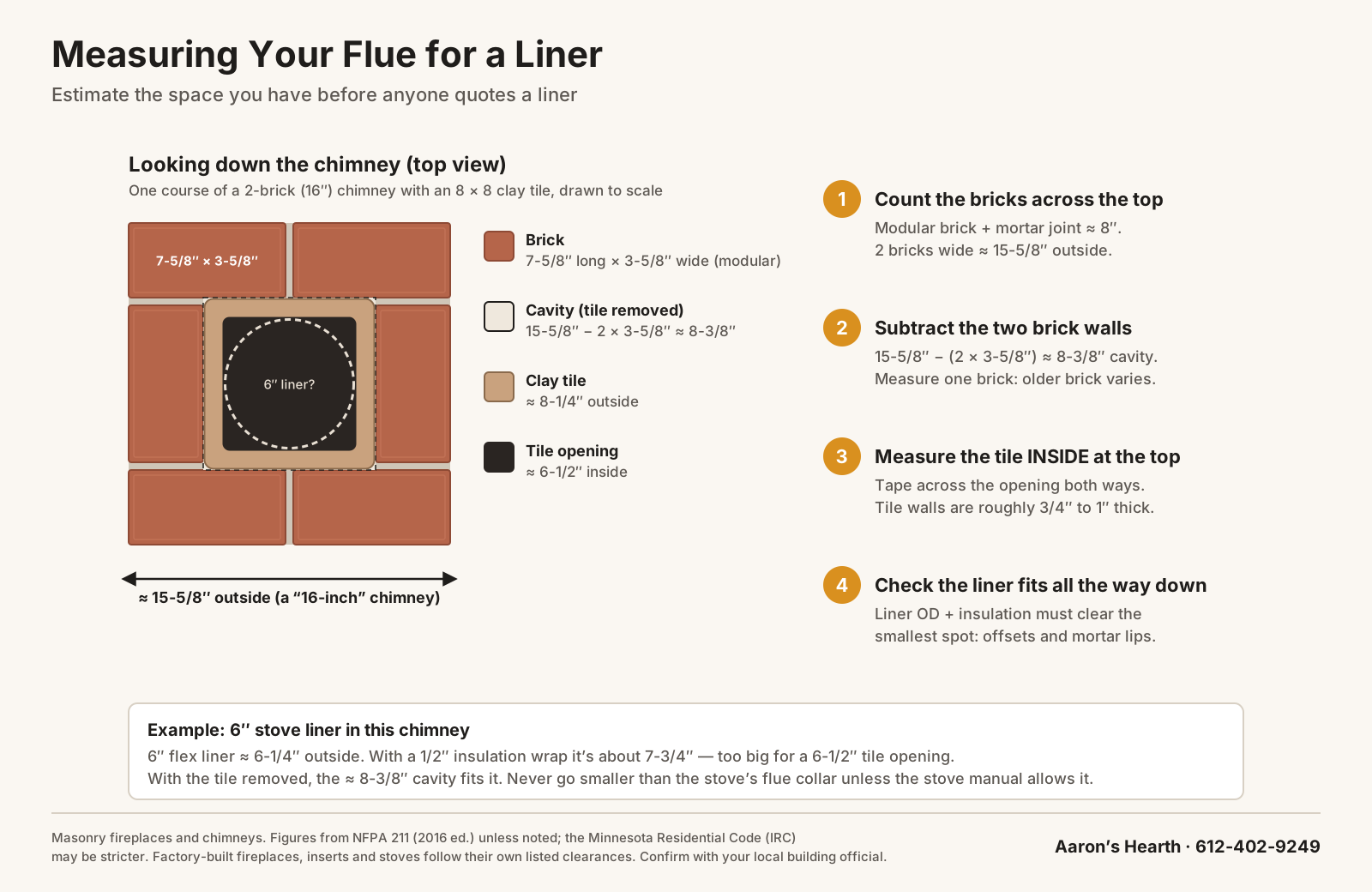
Top view of a chimney showing brick walls, clay tile and liner measurements

Estimate it from the outside

  • Count the bricks across the top. A modular brick is 7-5/8″ long; with its mortar joint that’s about 8″, so a 2-brick chimney is about 15-5/8″ across (called 16″), 2½ bricks about 20″.
  • Subtract the walls. Each brick wall is about 3-5/8″ thick. 15-5/8″ − 7-1/4″ ≈ 8-3/8″ of cavity between the bricks.
  • Measure one brick. Older or oversize brick changes the math.

Measure the tile at the top

  • Tape across the tile inside both ways. Common tiles are sold by outside size (8×8, 8×13, 13×13, 13×18); walls run about 3/4″–1″, so an 8×8 is roughly 6-1/2″ inside.
  • Rectangular tile inside area is a bit less than width × depth because of rounded corners.

Will the liner fit?

  • Flex liner outside is about 1/4″ bigger than its size. Insulation wrap adds roughly 1″ (1/4″ wrap) to 1-1/2″ (1/2″ wrap) to the diameter.
  • It has to clear the tightest spot — offsets, shifted tiles and mortar squeezed into the joints — not just the top.
  • Example: a 6″ liner with a 1/2″ wrap is about 7-3/4″ across. A standard 8½ × 13 tile is only about 6½″ on its narrow side, so the insulated liner won’t go down it — the tile comes out.
  • A camera scan (Level 2) is how we confirm that before quoting.
Manufacturer manuals

Installation requirements, straight from the source

A listed liner is only listed when it’s installed per its own manual. Key points below are summarized from each manufacturer’s instructions — always read the full manual for your exact product.

HomeSaver UltraPro (Copperfield Chimney Supply)

Installation & maintenance instructions for flexible stainless relining pipe

Listing
UL listed (file MH13768), tested to UL 1777; 3″–8″ round.
Insulation, wood & coal
Required. 1″+ clearance to combustibles: one 1/4″ FlexWrap or 1″ of mix. Under 1″: one 1/2″ wrap, two 1/4″ wraps, or 1″ of InsulationMix/TherMix.
Securing the wrap
Spray adhesive or water glass on the liner, foil facing out, one vertical seam, seam and ends taped with foil tape.
Mesh
Required: FlexWrap must be covered with ArmorMesh, clamped at the bottom and within 6″ of the top plate.
Sizing
Liner area ≥ stove collar. Fireplace: round liner ≥ 1/12 of the opening on a straight chimney, 1/10 with an offset.
Length
10–65 ft. Masonry walls at least 4″ of solid brick.
Open the manual

Dalsin Line Chim-A-Lator (Bernard Dalsin Mfg.)

Rigid & flexible stainless liner installation instructions (Rev. B, 2006)

Listing
3″–12″ round, 304 or 316 stainless; 316 required for coal.
Insulation
Unlined chimney: 1/2″ ceramic blanket (89 density) the full length. Not required in a lined, code-compliant chimney.
Securing the wrap
Edges butted, no overlap, never stretched (stretching thins it). Stainless wire every 12″–16″.
Mesh
Expandable stainless mesh with hose clamps over the blanket to protect it while lowering.
Sizing
Match the appliance outlet area. Fireplace: liner ≥ 10% of the opening (older edition). Chimney inside at least 1-1/8″ larger than the liner.
Shape & length
Do not reshape the liner. 8–75 ft.
Open the manual

BEST-Flex (New England Chimney Supply)

Installation instructions for BEST-Flex stainless liners, Models L, H, S & E

Listing
UL 1777 (US) for new and existing masonry chimneys; ULC S635 in Canada (existing only).
Insulation
Code-conforming chimney, liner not in tile: no wrap, 1″ space. Tiles removed: one 1/4″ BEST-Wrap. Zero clearance / no flue liner: at least 1″ of TherMix poured mix.
Securing the wrap
Trim for about 1″ of overlap; tape the full seam, plus 8″ strips across it every 12″.
Mesh
Retractable wire mesh sock over the wrap, clamped above the tee and at the top.
Sizing
Liner ≥ stove collar, ≤ 3× unless the stove says otherwise. Fireplace ≥ 1/12 of the opening. No field ovalizing.
Length
Chimney 10–100 ft. 2″ air space interior, 1″ exterior; noncombustible fire stops.
Open the manual

M-Flex (National Chimney Supply)

Installation instructions for M-Flex Model CB & AL stainless liners (CBIN-001, Rev. 05/10)

Listing
UL listed (file MH25531); 316L and 294C alloys.
Insulation
Required when clearances can’t be confirmed. Tiles removed from a code chimney: one 1/4″ Premier Wrap. Non-code / zero clearance: one 1/2″ Premier Wrap, or 1″ of Premier Mix. Always insulate exterior chimneys (294C).
Securing the wrap
Foil tape along the seam and across it about every foot.
Mesh
Premier Mesh protective wire sleeve over the wrap, clamped at the top and above the tee.
Sizing
Liner ≥ stove collar, ≤ 3×. Fireplace ≥ 1/10 of the opening. Ovalizing changes the area.
Length
Chimney 10–100 ft. 2″ air space interior, 1″ exterior.
Open the manual

Summaries checked October 2026 against each manufacturer’s instructions (BEST-Flex from a published copy of its manual). Manufacturers update their instructions; the linked document governs.

Want a second opinion on a liner quote?

Send the size, type and your chimney measurements to 612-402-9249. We’ll tell you whether it makes sense — including when it doesn’t.